

 Guide
Symptom guide
Is Your Refrigerator Cold Enough? How to Check It With a Thermometer
The dial says 3, the display says 37, but what is the real temperature inside? How to verify a refrigerator and…
Clicks, gurgles and pops are part of how a refrigerator works; tapping, thudding and frozen lettuce usually are not. A sound-by-sound guide, plus why the fresh-food side freezes things and how to correct it slowly.
By ApplianceCodeHQ Editorial Updated
Two complaints come up again and again with refrigerators that are otherwise working: “it makes strange noises” and “it froze my lettuce.” They share more than you might think. Both often come from air and refrigerant doing exactly what they should, and both are sometimes the visible end of a real problem, such as frost building up around a fan or a control set far colder than it needs to be. The trick is to tell the everyday from the unusual before you touch the settings or call for service. Sounds come first below, temperatures second.
Whirlpool’s support library puts it plainly: most refrigerator sounds show the appliance working as designed, and a new refrigerator will probably sound different from the one it replaced. Different fans, valves and cabinet materials make different sounds, so a change of tone after a replacement is not by itself a fault. LG adds that normal sounds seem louder at night, simply because the house is quieter.
| Sound | What causes it |
|---|---|
| Humming, whirring | Compressor and fans; louder after the doors have been opened or warm food added |
| Gurgling, bubbling, hissing | Refrigerant moving through the tubing after a cooling cycle |
| Sizzling or dripping | Water from defrosting landing on the defrost heater |
| Popping, cracking | Plastic walls and shelves expanding and contracting with temperature |
| Single click | A relay or valve switching; LG describes a valve that clicks for about 7 seconds once a day or about 3 seconds every hour on some models |
| Buzzing, thumping during ice making | The water valve and line filling the ice maker |
| Whoosh when a door opens | Air rushing in and out around the door gasket |
A few sounds have simple causes you can fix. Rattling often comes from items stored on top of the cabinet, a refrigerator that is not level, or one touching the wall or cabinets; LG suggests checking clearance at the back and sides and adjusting the leveling legs. Grinding or squeaking when you open a door usually means it rubs against a cabinet. Steady buzzing on a refrigerator with an ice maker that is not connected to water is the water valve trying to fill; Whirlpool says to turn the ice maker off in that case. Chattering while you dispense water can mean a kinked supply line.
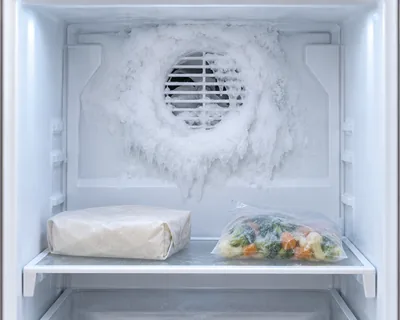
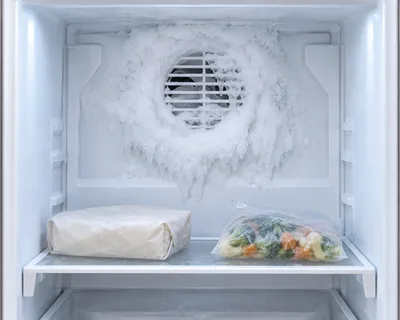
The one to take seriously is continuous tapping, rattling or a steady thud from inside the freezer. LG explains that thick frost can build up around the fan, or something can touch the blade. Its owner procedure is to move the food to a cooler or another refrigerator, unplug the unit and leave the doors open until all the frost melts, which it estimates takes about 24 hours in summer and up to three days in winter. If the same noise or an error code returns after that, LG says a service visit is necessary. Frost that keeps coming back points to a defrost or door-seal problem, which our frost guide covers.
Whirlpool recommends 37 to 40 °F for the fresh-food section and ships its refrigerators at 37 °F with the freezer at 0 °F. It warns that at 34 °F or below, food near the air outlets can freeze. So the first job is to find the real temperature, not the number on the dial; our thermometer guide shows how. If it really is too cold, these are the usual reasons, roughly from most to least obvious.
A freezer set well below 0 °F can push extra cold into the fresh-food side, because the two share air. On many dial models a lower number means warmer; confirm in your manual.
Items against the rear or side vents get cold air blown straight on them. Leave gaps and avoid tall containers that block airflow.
Whirlpool notes that an ice maker switched on without a water supply can make the fresh-food section too cold.
A refrigerator in a garage or unheated space cycles differently and can run colder inside.
Adjust by one degree or one notch, then wait 24 hours before judging or changing again.
Patience matters more than the size of the adjustment. A refrigerator full of food changes temperature slowly, and turning the control twice in an evening only makes the result harder to read. If the compartment stays below freezing after you have corrected the settings and the airflow and waited a full day, or if a display or temperature alarm keeps flagging a problem, the controls or a damper may be at fault, and that is a service call.
Not necessarily. Whirlpool says a new refrigerator will probably sound different. Check it is level and not touching the wall; otherwise listen for the unusual sounds above.
Manufacturers do not publish one threshold for every model. A noise that is new, continuous and comes with poor cooling or frost deserves attention.
That spot is often near a cold-air outlet. Keep delicate food away from the vents.
Whirlpool’s range is 37 to 40 °F. Move one step warmer at a time and keep the reading at 40 °F or below for food safety.
Sources: sound descriptions and temperature settings are quoted from LG and Whirlpool support pages.
LG US: Unusual noises from your LG refrigerator — checked 2026-11-05.
Whirlpool Product Help: Refrigerator Normal Sounds and Noises — checked 2026-11-05.
Whirlpool Product Help: Refrigerator Section is Too Cold — checked 2026-11-05.
How to read the real temperature with an appliance thermometer.
Guide
Symptom guide
The dial says 3, the display says 37, but what is the real temperature inside? How to verify a refrigerator and…
 Guide
Symptom guide
Visible frost does not identify a failed defrost part. Check the door and display, protect stored food and choose the…
 Error code
LG refrigerator · FF
The refrigerator reports a freezer-fan problem; frost can obstruct the fan on the covered models.
Check model first
Guide
Symptom guide
Soft ice cream, ice cubes that never set, or a freezer that reads 15 °F. Which checks owners can do, in which order, how…
Error code
LG refrigerator · rF
The refrigerator-compartment fan is not operating normally.
Check model first Guide
Symptom guide
Use the exact refrigerator and filter instructions for replacement, flushing and reminder reset. A filter light does not…
Thank you! Your feedback helps us make this page better.
Could not send. Please try again.